A Comprehensive Analysis of Ethyl Acetate Distillation Equipment
The boiling point of ethyl acetate (77.2℃) and it is prone to form azeotropes with water, ethanol, etc. with fixed boiling points.
Working principle: Based on the difference in boiling points for separation
The core of ethyl acetate distillation lies in using the difference in volatility between it and other components in its mixture (such as water, acetic acid, ethanol) to achieve separation. The boiling point of pure ethyl acetate is 77.2℃. When it is mixed with water and ethanol, several key low-boiling-point azeotrope mixtures are formed, whose boiling points are lower than any single component.
Device composition and classification
The distillation device for ethyl acetate varies greatly depending on the scale of use and purpose.
Simple laboratory distillation apparatus: Primarily used for the initial separation of ethyl acetate from the reaction mixture.
The core components include: a round-bottomed distillation flask, a condenser (usually straight or water-cooled), a receiving tube, and a conical flask as the receiver.
Industrial-scale core equipment: Mainly used for large-scale production.
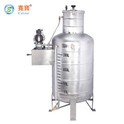
Reactor: The core equipment for industrial purification, it is equipped with sieve plate towers or packed towers to achieve efficient gas-liquid contact. To handle the formation of azeotropes, two sets of towers are often used: first, a crude ester is obtained in the first tower (about 83-94 wt%), then it is further refined in the second tower, and the final purity can exceed 99.5 wt%.
Reaction distillation tower: Combines reaction and separation into one process, enabling continuous removal of products, disrupting the reaction equilibrium and significantly increasing the conversion rate. The tower body is typically divided into three sections: the distillation section, the reaction section, and the stripping section.
Separator/Distiller: This device is used to treat the top condensate of the azeotropic tower, separating it into the organic phase (rich in esters) and the aqueous phase. The organic phase is partially refluxed and partially withdrawn.
Reboiler and condenser: Provide the tower with rising steam (steam heating is a common heat source) and the necessary reflux.
Auxiliary equipment: Provides support for the entire production process, such as raw material storage tanks, metering pumps, solid/liquid drying devices and control systems (DCS), etc.
Jun 15, 2026
A Comprehensive Analysis of Ethyl Acetate Distillation Equipment
Send Inquiry
Product Categories
Latest Products