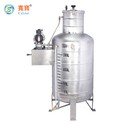
Overview of Acetone Solvent Recovery System
The core principle of the acetone solvent recovery system is to utilize the physical property differences between acetone and other substances (such as resins, inks, water, etc.) - mainly the boiling points - through distillation, rectification, and other processes to purify used and contaminated acetone, making it meet the standards for reuse in production.
Main Recovery Techniques
Based on the characteristics of waste acetone (such as types and concentrations of impurities), the following main recovery techniques are employed:
1. Atmospheric distillation
Principle: By taking advantage of the difference in boiling points between acetone and other impurities (acetone has a boiling point of approximately 56.5°C), the mixture is heated under normal pressure. This causes acetone to vaporize first and then condense back into a liquid.
Applicable scenarios: It is suitable for simple mixtures where the boiling points of impurities are much higher than that of acetone and the thermal sensitivity is not high. For example, the recovery of waste acetone containing high-boiling-point resins and pigments.
Advantages: Simple equipment, low investment cost, and easy operation.
Disadvantage: The purity of the recovered product is relatively low, and the separation effect for impurities with similar boiling points is poor.
2. Vacuum Distillation
Principle: Under vacuum conditions, the boiling point of a liquid decreases. By reducing the system pressure, acetone can be made to evaporate at a lower temperature, thus achieving separation.
Applicable scenarios:
Handle heat-sensitive substances and prevent decomposition or polymerization of acetone or impurities at high temperatures.
Deal with impurities whose boiling points are close to that of acetone.
Advantages: High recovery rate, high product purity, relatively low energy consumption, and capable of protecting heat-sensitive materials.
Disadvantages: The equipment is complex, requiring a vacuum system, and the investment and maintenance costs are relatively high.
3. Distillation
Principle: Based on distillation, a distillation column is added. Through multiple countercurrent contacts and mass and heat transfer between the gas and liquid phases inside the column, a more precise separation is achieved. This is currently the most mainstream and efficient recovery method.
The applicable scenario is that the purity of the required recovered acetone is very high (such as ≥ 99.5%), and the waste material may contain multiple solvents with similar boiling points (such as methanol, ethanol, butanone, etc.).
Advantage: The purity of the recycled products is extremely high and they can be directly reused in the main production process.
Disadvantages: The equipment is complex, occupies a large area, and has the highest investment and operating costs.
4. Permeation vaporization membrane separation
Principle: By using a special membrane that is highly permeable to organic substances, under the drive of vacuum and temperature difference, acetone molecules are preferentially allowed to pass through the membrane, while water or other impurities are retained, thus achieving separation.
This technology is particularly suitable for the separation of acetone-water azeotropes. It can break the azeotropic point and directly obtain anhydrous acetone with low energy consumption.
Advantages: energy-saving, environmentally friendly, no phase change, simple operation, and has significant advantages when dealing with specific systems.
Disadvantages: The membrane modules are costly, have high requirements for pretreatment, and have relatively small processing capacity.