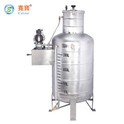
Ethane solvent recovery device
I. Core Objectives and Significance
Economic benefits: Ethane is an important chemical raw material (especially for the production of ethylene) and a high-quality fuel. Direct emission or incineration is a huge waste of resources. After recovery, it can be directly reused or sold.
Environmental protection and safety: Ethane is a flammable and explosive volatile organic compound (VOC). Recycling can significantly reduce VOC emissions, meet environmental protection regulations, and at the same time lower the explosion risk in the workplace.
Realizing circular economy: Forming a closed-loop use of solvents within the enterprise, reducing the cost of raw material procurement and the cost of handling waste solvents.
II. Main working principle and technical route
The boiling point of ethane is extremely low (-88.6°C), and it exists as a gas at normal temperature and pressure. Therefore, its recovery technology is different from that of conventional liquid solvents, mainly focusing on gas separation and liquefaction. The mainstream technologies include the following types, which are often used in combination:
Adsorption method (the most commonly used)
Principle: Utilize adsorbents (such as activated carbon, molecular sieves) to selectively adsorb ethane from the exhaust gas under normal temperature and high pressure. Then, after high temperature or low pressure treatment, the ethane gas with high concentration can be obtained.
Common processes: Pressure swing adsorption or temperature-dependent adsorption.
Advantages: Suitable for low-concentration and high-volume exhaust gases; mature technology, high degree of automation.
Disadvantages: The adsorbent needs to be replaced or regenerated regularly; the concentration of ethane after desorption is high but the pressure is low, and usually requires subsequent treatment.
Condensation method
Principle: By cooling the gas containing ethane below its dew point, it is liquefied and separated from the gas. Due to the low boiling point of ethane, deep cooling (such as -80°C to -100°C) or intermediate cooling (combined with compression and pressurization) is often required.
Grade separation condensation: It is often combined with pre-cooling water cooling and refrigeration units. First, moisture and high-boiling-point impurities are removed, and finally, ethane is recovered through deep cooling.
Advantages: The recovered product is liquid ethane, with high purity and can be directly utilized; the process principle is simple.
Disadvantages: Extremely high energy consumption for cryogenic treatment; Poor economic efficiency for treating low-concentration exhaust gases.
Membrane separation method
Principle: The separation is achieved by using a special polymer membrane that has different permeability rates for various gases. Ethane permeates faster than nitrogen, oxygen, etc.
Advantages: Compact design, no moving parts, simple operation; suitable for small and medium-sized scales.
Disadvantages: The membrane has a high cost and requires strict pre-treatment of gases (oil removal, dust removal); the single-stage recovery rate is limited and it is often used as a pre-treatment step or in combination with other technologies.