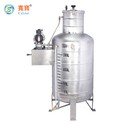
Ethanol Recovery Equipment Analysis
Working Principle
Most industrial ethanol recovery equipment is based on the core physical principle of distillation. Simply put, it separates alcohol (ethanol) from water by exploiting their different boiling points-ethanol boils at 78.3°C, while water boils at 100°C.
The basic operating process is as follows:
Heating and Evaporation: The dilute alcohol solution to be recovered is heated in the reboiler to a temperature slightly above the boiling point of ethanol.
Distillation and Purification: The resulting vapor mixture rises through the tower column, continuously contacting reflux liquid, enabling mass and heat transfer. This process gradually increases the alcohol concentration as the vapor ascends.
Condensation and Recovery: High-concentration alcohol vapor exiting the top of the tower enters the condenser, where it is cooled into liquid ethanol.
Reflux and Product Withdrawal: A portion of the condensed liquid returns to the top of the tower as reflux, ensuring continuous distillation; another portion is collected as the final product.
Main Equipment Types and Structures
Ethanol recovery equipment comes in various forms, ranging from large-scale towers to compact integrated systems, designed to meet diverse production scales and process requirements.
Alcohol Recovery Tower: This is the most common and essential unit. It constitutes a complete distillation system, primarily composed of the following components:
Reboiler: Located at the bottom, used for heating and storing the feed liquid.
Tower Column: Contains internal packing (such as stainless steel corrugated packing) or trays, serving as the core site for distillation.
Condenser: Cools high-concentration alcohol vapor from the top of the tower into liquid form.
Cooler: Further cools the final alcohol product.
Buffer Tank and Elevated Storage Tank: Used for temporary storage and material supply.
This equipment is typically constructed from SUS304 or SUS316L stainless steel to ensure corrosion resistance and product quality.
Alcohol Recovery Concentrator: This device combines evaporation concentration with alcohol recovery in one unit. It is particularly suitable for applications requiring both concentration of materials (e.g., herbal extracts) and recovery of alcohol contained within them.
Alcohol Recovery System: A more comprehensive automated unit that includes not only the recovery tower but also an automatic control system and reflux pump, enabling continuous, automated operation and reducing labor intensity.
Small-Scale Solvent Recovery Unit: A compact, portable device commonly used in laboratories or for small-batch, intermittent production. Typically equipped with explosion-proof design, it offers simple operation.
Applications
Ethanol recovery equipment is widely used, primarily for treating dilute alcoholic waste streams generated across various industrial processes:
Pharmaceutical Industry: Recovering alcohol from processes such as Chinese medicine extraction and chemical synthesis.
Food Industry: Recovering alcohol from brewing and seasoning production.
Chemical Industry: Recovering alcohol used as reaction solvents or cleaning agents.
Light Industry and Others: Solvent recovery in sectors such as cosmetics, fragrances, and coatings.