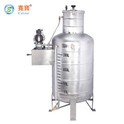
NMP solvent recovery device
I. The Necessity of Recycling
Economic aspect: NMP is expensive. The recycling rate can reach over 90% to 95%, which can significantly reduce production costs.
Environmental friendliness: NMP is classified as a hazardous waste. Direct discharge or improper treatment will cause severe environmental pollution. Recycling is an essential measure to achieve clean production and comply with environmental regulations.
Resource recycling: In line with the circular economy and the "dual carbon" goals.
II. Working Principle (Core Technology)
The mainstream technology is distillation (rectification), which is mainly divided into the following types based on different pressures and processes:
Atmospheric pressure distillation: The equipment is simple, but the operating temperature is high (the boiling point of NMP is approximately 202℃), which may lead to thermal decomposition of NMP and relatively high energy consumption.
Vacuum (reduced pressure) distillation (the most commonly used):
In a vacuum environment, the boiling point of NMP drops significantly (for example, at -0.095 MPa, the boiling point is approximately 130℃).
Advantages: Avoid thermal decomposition, ensuring the purity of the recovered product; relatively low energy consumption; safer operation.
Molecular sieve/membrane separation technology: As an emerging or auxiliary technology, it is used for dehydration or impurity separation in specific scenarios.
III. Typical System Composition and Process Flow
A complete recovery system typically includes:
Pre-treatment unit: Waste NMP storage tank, filter (for removing particulate impurities).
Core Recovery Unit:
Distillation tower/evaporator: Under vacuum and heating conditions, NMP is separated from high-boiling-point impurities (such as PVDF, carbon black, etc.).
Condenser: Condenses NMP vapor into liquid.
Vacuum system: Maintains negative pressure in the system, typically composed of vacuum pumps, buffer tanks, etc.
Post-processing unit:
Dehydration tower (if necessary): Remove trace amounts of water to obtain high-purity anhydrous NMP.
Adsorption device: Further removal of trace impurities and color.
Control system: PLC/DCS automatic control system, achieving precise control of temperature, pressure, liquid level and flow, as well as safety interlocks.
Finished product unit: High-purity NMP storage tank.
Basic process:
Waste NMP → Filtration → Preheating → Vacuum distillation → Condensation → (Dehydration/Adsorption) → High-purity NMP product
Residue (high boiling point substances) is regularly discharged and entrusted to a qualified unit for treatment.