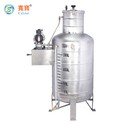
NMP solvent recovery unit
NMP solvent recovery units are primarily divided into two categories-exhaust gas recovery and waste liquid recovery-based on the type of feedstock (gas or liquid) and process principles, with distinct equipment configurations and core components for each.
Exhaust Gas Recovery Equipment Analysis
This type of equipment mainly treats NMP-containing exhaust gases generated in processes such as lithium battery coating. The mainstream technologies include rotary adsorption and refrigeration condensation methods.
1. Rotary Adsorption Recovery Unit
Currently, this is the preferred solution for treating large-volume, low-concentration NMP exhaust gases, relying on a cyclic process of "adsorption–desorption–cooling."
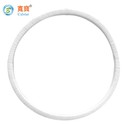
Core Component: Adsorption Rotary Wheel
The wheel serves as the heart of the system and is typically made of adsorbent materials such as zeolite molecular sieves or activated carbon fiber. It is segmented into three functional zones:
Adsorption Zone: As NMP-laden exhaust gas passes through, NMP molecules are captured by the adsorbent material, while clean air is discharged.
Regeneration Zone (Desorption Zone): Hot air (approximately 145°C) flows countercurrently to strip saturated NMP from the wheel, generating high-concentration concentrated exhaust gas.
Cooling Zone: The regenerated wheel is cooled to restore its adsorption capacity before entering the next cycle.
Auxiliary Systems
Pre-cooling System: Before entering the main unit, exhaust gas undergoes multi-stage cooling via heat recovery units, cooling water chillers, and chilled water coolers, partially condensing NMP and water vapor to reduce the load on the adsorption wheel.
Regeneration Heating System: Supplies the required hot air for the desorption process.
Post-treatment System: High-concentration exhaust gas enters a condenser where it is condensed into liquid NMP for recovery. Some systems also incorporate an activated carbon adsorption unit at the final discharge point as a safeguard.
Control System: Typically controlled by PLC or DDC automation, enabling integration with coating machines and safety interlocks.
Performance Indicators: Recovery efficiency reaches 97%–99%, recovered NMP concentration up to 85%, and emission levels can be reduced below 1 ppm.
2. Refrigeration Condensation Recovery Unit
This is a relatively simple system suitable for handling smaller airflow volumes with higher NMP concentrations.
Core Component: Refrigeration and Heat Exchange System
Compressor Condensation System: Provides low-temperature cold source via refrigeration cycles.
Multi-stage Heat Exchangers: Exhaust gas sequentially passes through heat recovery units, circulating water heat exchangers, and chilled water heat exchangers, gradually lowering temperature to induce NMP condensation.
Materials: Components in contact with NMP (e.g., condensers) are commonly made of 304 stainless steel, while fins are aluminum-based to ensure corrosion resistance and efficient heat transfer.
Auxiliary Systems
Activated Carbon Adsorption Unit: A honeycomb-shaped activated carbon filter installed at the outlet captures any residual NMP that did not fully condense, ensuring compliance with emission standards.
Performance and Integration: Units are typically designed as compact cabinet-style integrated systems. For example, Shenzhen Kejing's MSK-NMP-C200 model handles 200 m³/h airflow with a power consumption of approximately 1.5–1.8 kW.
Waste Liquid Distillation Recovery Equipment Analysis
This equipment is used to treat liquid waste containing NMP, achieving high-purity recovery through distillation.
Core Component: Distillation System
The distillation column separates NMP from impurities (primarily water) based on differences in boiling points. Systems often employ a dual- or triple-column series configuration, such as "dehydration tower + purification tower" or "first dehydration distillation unit + second dehydration distillation unit + NMP distillation unit." Key components include:
Reboiler: Supplies heat to vaporize NMP within the distillation column.
Condenser: Condenses gaseous NMP back into liquid form for collection.
Column Internals: Such as packing layers, which increase gas-liquid contact area and improve separation efficiency.
Auxiliary Systems
Waste Liquid Pre-treatment System: Includes filtration units to remove solid impurities from the waste liquid.
Vacuum System: Utilizes vacuum pumps to create negative pressure, reducing operating temperature and preventing thermal decomposition of NMP.
Cooling and collection system: includes a cooling tower or cooler, as well as a clean storage tank for storing high-purity NMP.