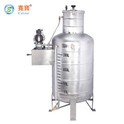
The solvent recovery machine for the mirror cleaning industry primarily delivers four key benefits: cost reduction, quality preservation, compliance, and safety, and is compatible with mainstream cleaning solvents such as hydrocarbons, IPA, and ethanol.
1. Economic benefits: Significant cost reduction
• Solvent procurement cost reduced by 80%-95%: With a recovery rate of 95%-98%, the regenerated solvent achieves 99.9% purity and can be directly reused.
• Hazardous waste disposal costs reduced by over 90%: Residue volume shrunk to 5%-10% of the original waste solvent, with a sharp decline in processing volume.
• Fast return on investment: Typically recovers the cost within 6-12 months, significantly reducing long-term cleaning expenses.
• Low energy consumption: Vacuum low-temperature distillation saves 30%+ more energy compared to traditional heating.
2. Stable Cleaning Quality: Suitable for Precision Mirrors
• Stable Purity: The regenerated solvent is free of impurities, moisture, watermarks, white spots, and residues, making it suitable for coating/lithography mirror applications.
• Batch Consistency: Avoid variations in new solvent batches, improve cleaning yield, and reduce rework.
• Compatible with thermal-sensitive solvents: protects hydrocarbons, IPA, etc., during low-temperature distillation without damaging solvent structure, ensuring stable cleaning performance.
3. Environmental Compliance: Zero Emission Risk
• VOC Emission Reduction: Enclosed recovery with minimal volatilization, achieving total non-methane hydrocarbon emissions far below national standards.
• Hazardous waste reduction: Minimal residue, compliant disposal, avoiding fines and production shutdown risks.
• Green Production: Closed-loop recycling, compliant with environmental policies, enhances corporate image.
IV. Safety and Management: Controllable Risks
• Explosion-proof design: The entire machine is explosion-proof, eliminating the safety hazards of flammable and explosive solvents.
• Workshop Safety: Enclosed operation with minimal odor and low volatility, safeguarding employee health.
• Simplified Management: Reduce solvent procurement, storage, and transportation to lower management costs and safety risks.