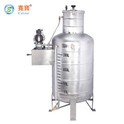
The use of solvent recovery machines in the sorting process of electronic waste plastics brings significant benefits in multiple aspects, primarily reflected in economic benefits, environmental sustainability, technical efficiency, and compliance enhancement. The following provides a detailed analysis:
1. Economic benefits
Reduce raw material costs: By efficiently recycling solvents, the purchase of new solvents can be reduced, directly lowering the operating costs of the sorting process.
· Resource recycling: The purity of recycled plastics is higher, which can enhance the market value of recycled plastics and reduce waste disposal costs (such as landfill or incineration costs).
· Energy consumption optimization: Modern solvent recovery machines are often equipped with energy recovery systems to further reduce energy consumption.
2. Environmental benefits
Reduce toxic waste emissions: Electronic waste plastics often contain harmful substances such as flame retardants and heavy metals. Solvent recovery can prevent them from entering the environment with discarded solvents, thereby reducing the risk of soil and water pollution.
Reduce carbon footprint: Solvent regeneration reduces the production demand for new petroleum-based solvents, indirectly reducing greenhouse gas emissions.
· Supporting circular economy: Promoting closed-loop recycling of plastics, reducing dependence on virgin plastics, and aligning with sustainable development goals.
3. Technical efficiency improvement
· Improve sorting purity: The solvent selectively dissolves specific plastics (such as ABS and PS), and the recycling machine purifies the solvent through distillation, condensation, and other steps to ensure stable sorting performance and enhance the quality of recycled plastics.
· Automation and Continuity: The integrated recycling system enables continuous operation, reduces production interruptions, and enhances sorting efficiency.
· Adaptation to complex materials: Given the complex composition of electronic waste plastics, the recycling machine can handle solvents containing impurities, enhancing process robustness.
4. Safety and compliance
Reduce safety risks: Organic solvents are typically flammable and explosive. The recycling machine reduces evaporation and leakage through a closed system, thereby improving the safety of the working environment.
· Compliance with environmental regulations: Strict control of hazardous waste (such as waste solvents) is an international practice (e.g., the EU WEEE Directive, China's Solid Waste Pollution Prevention and Control Law). Recycling machines assist in compliant disposal, thereby avoiding legal risks.
· Occupational health protection: Reduce employees' exposure to harmful solvent vapor to safeguard the health of operators.
Application Examples
. (Note: The original text appears to be an incomplete or unfinished sentence, hence the translation is also incomplete or placeholder.).
· Typical solvents: acetone, xylene, tetrahydrofuran, etc., selected according to different types of plastics.
The introduction of solvent recovery machines in the sorting of electronic waste plastics not only enhances the economic efficiency of resource recovery and material purity, but also represents a pivotal step towards environmental responsibility and technological modernization. It facilitates a shift from a "consumption-based" to a "recycling-based" sorting model, offering a solution that aligns with green manufacturing requirements for the electronic waste disposal industry. As global attention to plastic pollution control intensifies, such technology will become a standard configuration for the high-value recovery of electronic waste plastics.