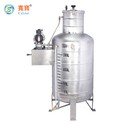
Chemical companies employ distillation equipment, commonly referred to as distillation machines, to recover solvents. Distillation works by heating the solvent to its boiling point, letting it evaporate, and then allowing it to condense back into a liquid state, which is then gathered and processed. The removal of contaminants, the division of liquids, and the concentration of solutions are only a few uses for distillation apparatus. It is a crucial tool for a variety of industries, such as petrochemical, pharmaceutical, and food manufacturing.
There are several different types of distillation equipment on the market, including fractional, batch, and continuous distillation. of equipment has distinctive qualities and is utilized for a certain purpose. distillation is used for small batches, whereas equipment for continuous distillation is utilized for larger batches of solvent recovery. on their respective boiling points, distinct components of a solution are separated using fractional distillation equipment.
In chemical facilities and laboratories, distillation equipment is frequently used to recover solvents. It is necessary for the creation of several compounds, such as paints, varnishes, and medicines. Significant advantages of distillation equipment use include reduced waste and cost-savings.
However, improper handling of distillation equipment might result in safety issues. High-temperature heating of flammable solvents is a step in the process that might cause fires and explosions. In order to prevent mishaps, it is imperative to adhere to safety procedures and guidelines and to make sure that the equipment is properly maintained.
In conclusion, distillation equipment is a crucial tool for solvent recovery in the chemical sector. It can reduce waste and save money, among other things, but it also comes with risks if improperly used. To avoid mishaps, it is essential to utilize the proper equipment for the intended purpose and to put safety first.