I. Core Working Principle
The solvent recovery device mainly operates based on the principle of physical separation, with the most commonly used and core technology being distillation. The basic process is as follows: Feeding and Preheating: Waste solvents containing impurities are collected in the raw material tank and sent into the device by the feed pump. Usually, they pass through a heat exchanger to exchange heat with the recovered pure solvents for preheating, saving energy. Heating and Evaporation: The preheated waste solvents enter the distillation pot or reboiler and are heated to their boiling point by the built-in heating system (such as electric heating rods, steam coils, or heat transfer oil), causing them to evaporate into vapor. Distillation Separation: The vapor enters the distillation column. Inside the column, there are packing materials or trays. During the vapor's ascent, it fully contacts with the partially condensed reflux liquid, undergoing multiple partial vaporizations and condensations. Components with lower boiling points and stronger volatility tend to enter the gas phase, while those with higher boiling points and less volatility remain in the liquid phase. This process significantly enhances the separation efficiency. Condensation and Liquidification: The pure solvent vapor from the top of the column enters the condenser and is cooled by a cooling medium (usually water or chilled water) to re-liquefy into pure liquid solvent. Collection and Storage: The liquefied pure solvent flows into the recovered solvent receiving tank, waiting for reuse. Residue Discharge: The high-boiling-point impurities (residue) remaining at the bottom of the distillation pot need to be regularly cleaned and discharged for professional treatment.
II. Main Components and Product Details
A complete solvent recovery device consists of the following core systems:
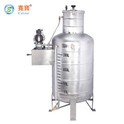
1. Main Equipment Distillation Pot: Material: Selected based on the corrosiveness of the solvent, commonly SUS304/316L stainless steel; for highly corrosive solvents, options like enamel or Hastelloy can be chosen. Heating Method: Electric Heating: Clean and precise temperature control, suitable for small and medium-sized devices. Steam Heating: Lower operating cost, but requires a steam source in the factory. Heat Transfer Oil Heating: Applicable for high-temperature conditions (>150°C). Details: Equipped with a liquid level gauge interface, thermometer interface, anti-dry-burning protection, and a bottom discharge valve for residue. Distillation Column: Internal Components: Packed Column: Uses high-efficiency random or structured packing such as Pall rings or Raschig rings, with large surface area, high separation efficiency, and low pressure drop. Tray Column: Such as sieve tray columns or float valve columns, with large processing capacity and good operational flexibility. Details: The column body usually has an insulation layer and is equipped with sight glasses for internal observation. Condenser: Types: Shell and tube condenser (most commonly used), plate condenser. Details: Ensure sufficient heat exchange area and controllable flow rate of the cooling medium. For low-boiling-point solvents, a secondary condensation (chilled water) may be required to ensure recovery rate.
2. Power and Conveyance System Vacuum Pump: Function: Reduces system pressure, thereby lowering the boiling point of the solvent. This is crucial for heat-sensitive solvents (those prone to decomposition or polymerization at high temperatures), significantly reducing energy consumption. Types: Water ring vacuum pump, rotary vane vacuum pump, Roots vacuum pump, etc. Feed Pump/Conveyance Pump: Types: Magnetic drive pump, diaphragm pump, etc., ensuring leak-free conveyance.
3. Control System (Intelligent Core) Control Core: PLC (Programmable Logic Controller) or DCS (Distributed Control System). Human-Machine Interface: Color touch screen for setting parameters, displaying process flow, real-time data monitoring, and alarms. Automation Functions: Automatic Feeding: Automatically sucks in waste solvents according to the set quantity. Programmed Temperature Rise: Automatically controls heating power according to the preset curve. Automatic Fraction Switching: Automatically switches different fractions (such as the head fraction, main fraction, and tail fraction) to different receiving tanks based on temperature or time. Automatic Residue Discharge: Automatically or semi-automatically discharges the residue at the bottom of the pot after the program ends. Safety Interlocks: Automatically cuts off heating and alarms in case of over-temperature, over-pressure, water shortage, or abnormal liquid level.
4. Safety and Environmental Protection System
Explosion-proof Design: For flammable and explosive solvents, the entire system should be equipped with explosion-proof motors, explosion-proof electrical appliances, and explosion-proof instruments, in compliance with ATEX or relevant national standards.
Nitrogen Protection System: Nitrogen is introduced into the system to reduce the oxygen concentration and prevent the formation of explosive mixtures of solvent vapor and air.
Cooling Water Protection: In case of cooling water interruption or insufficient pressure, an automatic alarm will sound and heating will be stopped.
Tail Gas Treatment Device: Connected to activated carbon adsorption tanks, condensers, etc., it treats non-condensable gases to ensure compliance with emission standards.
Pressure/Vacuum Safety Valves: To prevent equipment from overpressure or collapse.