Analysis of Alcohol Distillation Recovery System
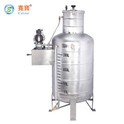
Industrial waste alcohol distillation equipment is a complete set of equipment specifically designed for treating low-concentration waste alcohol solutions generated in industrial production. It purifies the alcohol through distillation to achieve alcohol recovery and reuse.
The biggest difference between this device and ordinary distillation equipment lies in that it is not only for purification but also to address environmental protection issues and reduce production costs.
Core working principle:
The principle is based on the fact that the boiling point of alcohol (ethanol) (78.3℃) is lower than that of water (100℃). When heating the alcohol mixture, alcohol will turn into vapor before water, and these vapors are guided through a condensation device to cool down and re-convert into liquid form, thereby obtaining a liquid with a higher alcohol concentration.
The entire process is a continuous evaporation and condensation cycle.
Pre-treatment and feed: Waste alcohol is pumped from the storage tank into the system by a pump. Some advanced designs will first pass through a filtration device to remove solid impurities, and then through a preheater to utilize the waste heat generated by distillation for preheating, in order to save energy.
Distillation separation (core): The preheated waste liquid enters the distillation tower (refining tower). In the tower, alcohol vapor rises and undergoes a sufficient heat and mass exchange with the reflux liquid, achieving efficient separation of alcohol from water and other impurities.
Condensation and recovery: The high-concentration alcohol vapor from the top of the tower enters the condenser and is cooled into liquid alcohol. Some of the condensed liquid will be returned to the top of the tower as reflux liquid to ensure the separation effect.
Product and waste liquid treatment: The final product obtained is a high-concentration alcohol product that meets the requirements, while the wastewater (residue) discharged from the bottom of the tower needs to be treated and can be discharged only after meeting the standards.
Technical features and selection considerations:
High material requirements: All parts in contact with the material, such as the tower body and condenser, are made of stainless steel to prevent contamination and corrosion.
Processing capacity: It can purify 30-50 degree dilute alcohol to 90-95 degree high-concentration alcohol. If higher purity (such as anhydrous alcohol) is required, additional processes such as molecular sieve dehydration can be added.
Operation mode: Modern industrial devices mostly adopt continuous production, with high efficiency. For small batches or special components of waste liquid, there are also intermittent (repeated recovery) devices.
Energy-saving design: Modern devices generally adopt multi-tower multi-effect refining technology (such as three towers and three effects), through the hierarchical utilization of heat energy, which can achieve a comprehensive energy saving of over 60%. In addition, measures such as using waste liquid preheating and flash evaporation to recover low-pressure steam can also significantly save energy.
Main application fields:
Industrial waste alcohol distillation devices are widely used in various industries that produce waste alcohol:
Pharmaceutical industry: Recycled from extraction, synthesis, etc. processes.
Food/brewing industry: Recycled low-alcohol tailings or cleaning alcohol.
Chemical/light industry: Recycled as solvents or cleaning agents.
Others: Can also be used for the recovery of other organic solvents such as methanol, acetone, etc.