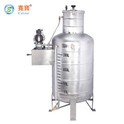
Hydrocarbon solvent recovery device
I. Core Working Principle
The hydrocarbon solvent recovery device is mainly based on the "physical separation" principle, separating the useful solvents from the impurities (such as oil stains, resins, pigments, particulates, etc.) in the waste solvents. The most mainstream and efficient technology is "distillation", which can be further divided into:
Atmospheric distillation: Suitable for solvents with lower boiling points and simpler compositions. The equipment is simple, but the energy consumption is high. It may not be applicable to heat-sensitive solvents.
Vacuum (decompression) distillation: The most commonly used and most advanced technology at present.
Principle: By creating a vacuum, the pressure within the system is reduced, thereby significantly lowering the boiling point of the solvent.
Advantages:
Low-temperature recovery: Preventing high temperatures from causing solvent decomposition, carbonization or creating safety hazards.
Energy saving: The required heating temperature is low, thus saving energy.
Adaptable: Capable of handling solvents with higher boiling points or those that are heat-sensitive.
Molecular distillation: It is used for the precise separation of materials with extremely high boiling points or those that are highly sensitive to heat. It is widely applied in the field of specialty chemicals.
II. Main Process Flow (Taking vacuum distillation as an example)
A standard recovery process usually includes the following steps:
Feedstock and Pre-treatment:
The waste solvents are filtered to remove large particles of impurities.
Stored in the raw material tank.
Heating and evaporation:
The waste solvents were pumped into the distillation vessel.
In a vacuum environment, indirect heating is achieved using hot water, heat transfer oil or steam through jackets or coils.
The solvent vaporizes at a lower temperature and separates from the non-volatile impurities.
Condensation recovery:
The pure solvent vapor that has vaporized enters the condenser (which is usually of the tube or spiral plate type).
It is cooled by water and then condensed into pure liquid solvent.
Solvent collection:
The condensed liquid solvent flows into the recovery solvent storage tank and is reserved for reuse after being tested.
Waste residue disposal:
The concentrated waste liquids such as oil sludge and resins remaining at the bottom of the distillation vessel will be cooled down and then handed over to qualified units as hazardous waste for disposal.
The advanced equipment is equipped with an automatic slag-discharging system, which can enhance efficiency.
Vacuum system:
The system maintains the required vacuum level by having a vacuum pump (such as a water ring vacuum pump or a rotary vane pump) continuously operating.
Control System:
Modern devices all adopt PLC automatic control systems, which can realize functions such as one-button start/stop, automatic control of temperature/pressure/liquid level, and safety interlock alarms. The operation is safe and simple.