Industrial Alcohol Recovery Equipment Recovery Technology Analysis
The core technologies of industrial alcohol recovery are all centered around the separation problem of the ethanol-water azeotropic system. Based on the difference in boiling points, we use a distillation tower for purification. However, conventional distillation can only increase the ethanol concentration to approximately 95.6% (volume fraction), and cannot directly obtain higher-purity anhydrous ethanol.
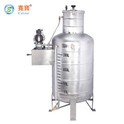
Alcohol recovery tower: The most common equipment, widely used in the purification of dilute alcohol in the pharmaceutical, food, and chemical industries. Its basic configuration can increase the concentration of 30-50 degrees alcohol to 93-95 degrees.
Multifunctional alcohol recovery concentrator: Integrating advanced evaporation, precise separation and energy-saving technologies, it can handle more complex material systems.
Three-effect alcohol recovery system: An efficient multi-effect distillation device, particularly suitable for large-scale continuous production, with significant economic benefits.
Integrated vacuum flash evaporation device: Designed for handling heat-sensitive materials or low-concentration wastewater, it can efficiently recover alcohol at low temperatures and prevent the destruction of active components.
For engineering applications, energy conservation and cost reduction are of utmost importance. Multi-effect distillation and supergravity distillation are two advanced technologies that deserve special attention.
Multi-effect distillation: In this process, the reboiler of the subsequent effect functions as the condenser of the previous effect. Through the repeated utilization of thermal energy, significant savings in steam consumption and reduction in the amount of circulating water are achieved. The key indicator is that the overall energy savings per ton of solvent exceed 60%, and the investment recovery period is only about 9 months.
Hypergravity distillation: This technique utilizes the centrifugal force field generated by rotation to enhance the contact between gas and liquid, significantly improving the separation efficiency. Its advantages include extremely small equipment footprint (a 1.2-meter device is equivalent to a 15-meter traditional tower), an alcohol recovery rate of up to 95-99%, a purity of up to 99.9%, and a 30-50% reduction in energy consumption compared to traditional equipment.