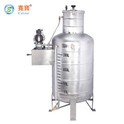
Analysis of Alcohol Distillation Apparatus
The core principle of an alcohol distillation apparatus is to separate and purify alcohol by exploiting the difference in boiling points between alcohol and water, producing industrial-grade alcohol with a concentration of approximately 95%. This concentration actually corresponds to an azeotropic point, meaning that higher-purity anhydrous alcohol cannot be obtained through simple distillation alone.
Its basic principle is simple: the boiling point of alcohol (78.3°C) is lower than that of water (100°C), so when heated, alcohol vaporizes first and is then condensed and collected.
Key Components and Industry Standards
In addition to the main distillation column, a complete system requires the following key components to work together:
Distillation釜 (reboiler): Located at the bottom of the tower, it is used to heat the mixed liquid and generate steam. Typically designed as a U-tube heat exchanger for easy disassembly and cleaning.
Condenser: Located at the top of the tower, it condenses alcohol vapor into liquid. It is typically a shell-and-tube or coil-type structure.
Reflux device: returning a portion of the condensed liquid back to the top of the column, which is crucial for improving product purity.
Control System: Real-time monitoring and control of critical parameters such as temperature and pressure to ensure stable and safe production.
Safety and Operational Practices
Due to the flammable and explosive nature of alcohol, safety design for the entire system must be prioritized:
Material selection: Components in contact with alcohol (tower body, piping, valves) must be made of stainless steel (e.g., SUS304) to prevent corrosion and contamination.
Explosion-proof design: All electrical equipment must meet explosion-proof requirements; the workshop must have proper ventilation and pressure relief facilities.
Static grounding: All equipment and pipelines must be reliably grounded to prevent static charge accumulation.
Operating Procedures: Establish strict operating guidelines covering startup, shutdown, and emergency response.
In operation, the following should also be noted:
Batch and continuous: small-scale production typically uses batch distillation, while large-scale industrial production employs continuous distillation, which offers higher efficiency and more consistent product quality.
Reflux ratio: The reflux ratio is a key parameter affecting product purity and yield. A higher reflux ratio increases product purity but reduces yield. For example, when purifying dilute alcohol to 90%-95%, increasing the reflux ratio can further enhance purity.
Feed concentration: The alcohol concentration of the feed directly affects production efficiency and energy consumption. Typically, dilute alcohol with a concentration of 30%–70% is recovered, and the purification range can reach 30°–95°.
Safety monitoring: During operation, continuously monitor the temperature, pressure, and liquid level inside the tower, and control the alcohol content in the residual liquid (typically required to be ≤3%).