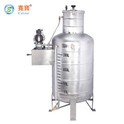
Introduction to Centrifugal Oil Filters
Centrifugal oil filters are purification devices that utilize the centrifugal force generated by high-speed rotation to efficiently separate oil, water, and solid impurities based on their different densities.
Its core advantage lies in the fact that it does not require filter screens or filter elements and other consumables, has low operating costs, and can effectively remove fine particles and free water. It is suitable for various industrial and edible scenarios where high oil cleanliness is required.
Core working principle: High-speed separation based on specific gravity
Imagine a high-speed rotating washing machine spin-drying drum. When the oil enters the core component of the device - the high-speed rotating drum (with a speed of up to 4000-8000 revolutions per minute), it generates a powerful centrifugal force equivalent to more than 2000 times the force of gravity.
Stratification: Under the action of a huge centrifugal force, substances of different densities are rapidly stratified.
The solid particles with the highest density (such as metal shavings and sand and gravel) are flung to the outermost layer, closely adhering to the inner wall of the drum.
Medium-density water forms an intermediate layer.
The purest oil with the lowest density remains in the innermost layer.
Discharge: The purified oil, water and impurities are discharged through different outlets respectively, thus achieving separation.
Main Features and Advantages
No consumables, low cost: This is its most prominent advantage. Unlike plate and frame or vacuum oil filters that require frequent replacement of filter screens and filter elements, the centrifugal oil filter only needs to be cleaned of the separated impurities regularly, reducing long-term operating costs by 30% to 50%.
High processing efficiency: It can handle large flow rates and quickly purify oil products. For instance, some equipment can reduce the pollutant particles in the oil by 2,000 to 5,000 times in just one cycle.
Wide application range: It can not only process industrial lubricating oil and hydraulic oil, but also be used for the refining of edible oil (such as rapeseed oil and peanut oil).