Dichloromethane waste gas adsorption and recovery type
Waste gas adsorption and recovery type
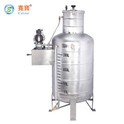
This type of equipment is designed for the volatile dichloromethane-containing waste gas (VOCs) during the production process. It has become a standard environmental protection facility in recent years for industries such as lithium battery separators, pharmaceuticals, and new materials when they expand production.
1.Working Principle: Combined Deep Purification
Due to the large air volume and significant concentration fluctuations of dichloromethane tail gas, it is difficult for a single technology to achieve efficient recovery with high energy consumption. Currently, the mainstream approach is to adopt a combined process of "pre-treatment + condensation + membrane separation + adsorption".
The first step (pre-treatment): Remove particulate matter and acidic corrosive components (such as chloride ions Cl-) from the exhaust gas to protect the subsequent core equipment.
The second step (compression and condensation): By applying pressure and lowering the temperature, the high-concentration dichloromethane is condensed into a liquid state for recovery first.
Step 3 (Membrane Separation): Utilize gas separation membranes to selectively enrich dichloromethane and further enhance the recovery rate.
Step 4 (Adsorption Control): Finally, the residual concentration is treated to below the emission standard through a resin or activated carbon adsorption tower.
2. Advanced Process Cases and Parameters
Emission Standard: According to the "Pollutant Discharge Standard for the Petroleum Chemical Industry" (GB31571-2015), the emission limit for dichloromethane is 100mg/m³. However, equipment using new technologies can achieve ultra-low emissions of ≤20mg/m³.
Energy consumption and cost:
Compared with the traditional single-activated carbon adsorption and desorption technology, the new "condensation-absorption-adsorption" coupling process can reduce energy consumption by more than 30% and cut environmental protection costs by approximately 60%.
In the field of lithium battery separators, domestic equipment not only fills the technological gap but also costs 25% less than imported equipment, with energy consumption reduced by half.
Recovery rate: The system's adsorption efficiency is typically ≥ 95%, and the actual annual recovery rate based on the input volume can reach over 70%.
Material requirements: As dichloromethane is corrosive when containing water (with free chlorine), the key components of high-end equipment (such as compressors and tanks) are mostly made of 316L stainless steel or even titanium (TA2) to prevent corrosion.
3. Typical Application Industries
Lithium battery separator: It is used for the recovery of solvents in the wet-process separator production line, which is currently the most widely applied field.
Ultra-high molecular weight polyethylene (UHMWPE) fiber: Recover the solvents used in the production process.
Pharmaceutical and chemical industry: Recovery of dichloromethane that volatilizes during the production process of active pharmaceutical ingredients.