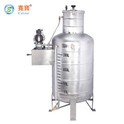
Pressure reduction and solvent recovery device
The pressure-reducing solvent recovery device, in simple terms, is a piece of equipment that operates under a pressure lower than that of the atmosphere. It utilizes the principle that the boiling point of solvents decreases, and through heating for evaporation and cooling for condensation, it purifies and recovers used or mixed solvents.
Its core value lies in:
Cost reduction and efficiency improvement: Enable the expensive solvents to be recycled and reused, significantly reducing procurement and processing costs.
Environmental compliance: Reduce the emission of volatile organic compounds (VOCs) and meet increasingly stringent environmental requirements.
Ensuring safety and health: Minimizing the exposure of laboratory or production personnel to harmful solvents and improving the working environment.
Working principle and typical composition
The principle of pressure reduction solvent recovery is based on physical properties: the boiling point of a liquid decreases as the environmental pressure decreases. By creating a vacuum environment in a closed system, the solvent can boil and evaporate at temperatures far below its normal pressure boiling point, which is both safe and energy-efficient.
A standard device is usually composed of the following core components:
Distillation/Heating System: Usually consists of a heating chamber, an evaporator or a distillation vessel, responsible for uniformly heating the waste solvent to cause it to vaporize.
Vacuum system: Comprising a vacuum pump and a vacuum controller, it is the core component of the entire device. It is responsible for creating and maintaining the negative pressure environment required by the system.
Condensation Recovery System: Composed of a condenser and a collection bottle/syringe. The high-temperature solvent vapor undergoes heat exchange with the cooling medium (water or refrigerant) here, re-condensing into a liquid state of the solvent, thereby achieving collection.
Exhaust gas treatment system (optional): Mainly consists of an activated carbon adsorption device, which is used to adsorb the trace harmful gases that are not completely condensed by the vacuum pump and ensure that the final discharged gas is clean and odorless.
Control System: Through PLC or touch screens, etc., the heating temperature, vacuum degree and condensation conditions can be precisely controlled to ensure the safety and stability of the recovery process.
Several common technical forms
"The vacuum solvent recovery device" is a broad concept. Depending on the application scenarios, there are various implementation forms:
Laboratory solvent recovery device: Usually a small tabletop system, compact and portable, it is used in conjunction with rotary evaporators and other equipment to recover the small amounts of precious solvents remaining after experiments.
Explosion-proof industrial solvent recovery machine: Suitable for industrial scenarios such as chemical production and coating that involve risks of flammability and explosiveness. The equipment must obtain national explosion-proof certification and adopt safety designs such as full enclosure and anti-static measures.
Intelligent vacuum distillation system: This represents the advanced technological direction, equipped with precise frequency control and gradient pressure programs, capable of intelligently handling complex mixed solvents and achieving efficient separation and continuous operation.
Hybrid process system: For the treatment of complex exhaust gases, a combined process of "condensation + adsorption + catalytic combustion" may be adopted to achieve compliance with emission standards.
Jun 08, 2026
Pressure reduction and solvent recovery device
Send Inquiry
Product Categories
Latest Products