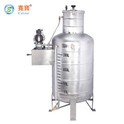
Solvent recycling machines for cleaning plastic products, especially in industrial production or professional recycling fields, can bring a series of significant economic, environmental, and operational benefits. The following is a detailed explanation of its main advantages:
1. Significantly reduce the cost of solvent procurement
·Core advantage: The solvent recovery function can distill and purify used dirty solvents (such as alcohols, esters, and hydrocarbon solvents used to remove ink, oil, and adhesives), with a recovery rate typically reaching 80% -95%.
·Effect: This means that companies only need to supplement a small amount of new solvents to maintain production cycles, which can save huge solvent procurement costs in the long run.
2. Reduce the cost and responsibility of hazardous waste treatment
·Environmental compliance: Used waste solvents are classified as hazardous waste, with high treatment costs (requiring professional institutions to dispose of them) and environmental legal responsibilities.
·Reduction: The recycling machine separates and concentrates pollutants (plastic powder, ink, resin, etc.) from waste solvents into a small amount of residue, reducing the volume of hazardous waste by 70% -90%, greatly reducing processing costs and environmental risks.
3. Improve cleaning efficiency and process stability
·Purity stability: The recovered solvent has a high purity, which can ensure consistency and stability of the cleaning effect, and avoid problems such as unclean product cleaning caused by solvent contamination.
·Continuous production: It can achieve on-site recycling and reuse, reduce production interruptions caused by waiting for new solvents or processing waste solvents, and improve production efficiency.
4. Resource Recycling and Sustainable Development
·In line with the circular economy: transforming the linear model of "use waste" into a closed-loop of "use recycling reuse" to improve resource utilization efficiency.
5. Specific advantages applicable to plastic cleaning
·Handling impurities: Oil stains, label adhesives, pigments, and other impurities generated during plastic crushing and cleaning can be effectively separated, and the recovered solvents are particularly suitable for reuse in cleaning processes with preliminary or moderate cleanliness requirements.
·Flexible adaptation: Suitable solvents and recycling process parameters can be selected based on different types of plastics (such as PET, PE, PP, etc.) and pollutants.
In summary, for large-scale production or recycling enterprises that frequently use solvents to clean plastic products, introducing solvent recycling machines is a high return investment. It directly achieves the four major goals of cost reduction, efficiency improvement, pollution reduction, and risk control from the core link, and is an important tool for achieving clean production and sustainable development.