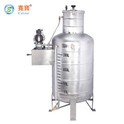
The introduction of solvent recovery machines is a typical win-win investment for health product enterprises in terms of cost reduction, efficiency improvement, compliance, and environmental protection. It not only directly reduces production costs, but also enhances the comprehensive competitiveness and social image of enterprises.
1, Direct economic benefits: significant cost reduction
1. Significantly reduce solvent procurement costs:
·In the production of health products, many extraction, purification, crystallization, and cleaning processes use large amounts of organic solvents (such as ethanol, acetone, ethyl acetate, petroleum ether, etc.). These solvents are usually expensive.
·The solvent recovery machine can efficiently distill and purify used waste solvents, with a recovery rate typically reaching 80% -95%. This means that companies only need to supplement a small amount of new solvents to maintain production, directly and significantly reducing raw material procurement costs.
2. Reduce the cost of hazardous waste disposal:
·Waste solvents are classified as hazardous waste, and their disposal costs are very high. Professional hazardous waste treatment companies will charge high collection, transportation, and processing fees.
·After using the recycling machine, the vast majority of waste solvents are recycled, and the total amount of hazardous waste that needs to be transported for treatment is sharply reduced, thereby significantly reducing the expensive cost of hazardous waste disposal.
2, Production operation and quality assurance
1. Ensure product quality and consistency:
·High quality solvent recovery machines can recover solvents with high purity through precise temperature control, vacuum distillation, and other technologies. Their quality can be comparable to new solvents, ensuring the extraction efficiency of effective ingredients in production and stable final product quality.
·Avoiding impurities that may be introduced due to the use of impure solvents, thereby affecting the safety, color, and taste of health products.
2. Ensure the stability of the production supply chain:
·Enterprises no longer rely entirely on external suppliers to provide new solvents. When facing market price fluctuations, supply shortages, or logistics delays, one's own recycling capacity can play an important buffering and guarantee role, ensuring the continuity and stability of the production line.
3. Improve work efficiency and on-site management:
·Realized on-site recovery and reuse of solvents, shortening material turnover time.
·Reducing the accumulation of waste solvent drums in the factory area makes the working environment cleaner and safer, which is conducive to promoting 5S or lean production management.
3, Safety and Compliance
1. Reduce security storage risks:
·The long-term storage of waste solvents poses safety hazards such as fire, explosion, and leakage. Timely recycling and disposal have reduced the storage volume and storage time of hazardous materials in the factory area, directly improving the intrinsic safety level of the factory.
2. Meet increasingly strict environmental regulations:
·The regulation of hazardous waste is becoming increasingly strict worldwide. The use of solvent recovery machines is a favorable proof for enterprises to actively upgrade their environmental protection and respond to environmental law enforcement inspections. It can help enterprises better meet various environmental regulations and avoid fines or production stoppage risks caused by compliance issues.
Examples of application scenarios
In the health product industry, solvent recovery machines are particularly suitable for the following process steps:
·Extraction of plant active ingredients: such as using ethanol to extract active ingredients from Ganoderma lucidum, ginseng, ginkgo leaves, etc.
·Extraction of oils and fat soluble components.
·The cleaning process of production equipment.
summary
For the health product industry, solvent recovery machines are far more than just cost saving tools. It is a strategic equipment that integrates economic benefits, environmental benefits, social benefits, and management benefits. In the fiercely competitive market environment, investing in solvent recovery machines is a wise choice for enterprises to move towards refined operations, green manufacturing, and sustainable development.
Simply put, it allows businesses to produce more stable and high-quality products with less money, while also becoming excellent corporate citizens responsible for the environment.