1. Directly reduce the procurement cost of cleaning agents
Ultrasonic cleaning commonly uses organic solvents such as hydrocarbons, isopropanol, trichloroethylene, and white oil. The single-use cleaning process results in significant solvent loss, requiring continuous procurement of new solvents when waste liquids are discarded.
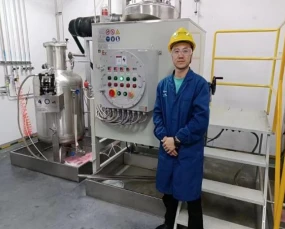
2. The recycling machine purifies dirty solvents through distillation, removing oil stains, metal powders, polishing wax, and impurities. The regenerated solvent achieves purity close to that of new liquid, enabling repeated use by being recycled into the ultrasonic tank. This process can reduce solvent procurement by 70% to 95%.
3. Under long-term production, significantly reducing consumable expenses allows small and medium-sized cleaning plants to recoup their costs in about six months.
2. Stabilize Ultrasonic Cleaning Quality
Dirty solvents containing large amounts of metal debris, grease, and wax deposits can reduce the ultrasonic cavitation cleaning effect, leading to whitening, water marks, oil residue, poor cleaning performance, and high rework rates on the workpieces.
2. After distillation and recovery, the solvent impurities and high-boiling-point oil stains are completely separated, ensuring stable cleanliness of the cleaning solution, uniform ultrasonic cleaning effects, and reduced defective products and rework labor.
3. Avoid frequent complete tank replacement with new solvents. Maintain stable concentration and cleaning parameters for long-term use, suitable for high-precision hardware, optical lenses, electronic components, and other high-demand cleaning applications.
3. Significant Reduction in Hazardous Waste Treatment Costs
1. Wasted organic solvents are classified as hazardous waste and must be disposed of by qualified entities at high fees, with charges based on weight-higher production volumes result in higher costs.
After recycling, only a small amount of high-concentration residue (oil sludge, metal slag) hazardous waste remains, with the waste liquid output reduced by 90%, significantly lowering the costs of hazardous waste removal and disposal.
3. Reduce the frequency of hazardous waste transportation and simplify the management of environmental records and hazardous waste declaration.
4. Environmental Compliance and Avoidance of Penalty Risks
Directly dumping waste liquids and storing waste solvents carelessly violates the "Solid Waste Law" and the "Water Pollution Prevention and Control Law," making them highly prone to fines and production suspension for rectification by environmental inspections.
2. Solvent is recovered through sealed distillation, with the entire process being airtight to prevent volatile emissions. This significantly reduces VOC waste gas in the workshop, meeting the requirements for factory waste gas treatment and environmental impact assessment approval.
3. No waste liquid discharge is required, eliminating the need for complex wastewater treatment facilities, making it easy for small ultrasonic cleaning workshops to meet standards.
5. Improve the workshop working environment and enhance safety
Repeated use of dirty solvents continuously emits pungent organic waste gases, irritating the respiratory tract. Recycling and reusing them reduces the frequency of opening and replacing solutions, significantly alleviating workshop odors.
2. Most solvent recovery machines are equipped with explosion-proof, temperature control, overheat shutdown, and pressure protection devices, featuring closed-loop distillation, which reduces fire and explosion hazards compared to long-term open storage of large quantities of dirty solvents.
3. Reduce frequent transportation and disposal of large amounts of waste solvents to minimize personnel exposure to chemicals and risks of slipping or burns.
6. Improve production efficiency and reduce man-hours
1. There is no need to frequently empty the ultrasonic cleaning tank or replace with new solvent, reducing downtime for liquid replacement and improving production line efficiency.
2. Residue can be collected and cleaned regularly without the need for manual filtration or sedimentation of dirty solvents, eliminating the use of auxiliary consumables such as filter cotton and filter paper, thereby saving labor and auxiliary material costs.