Cleaning agent recovery and reuse equipment
The core of the cleaning agent recovery and reuse equipment is based on the principle of distillation, which purifies used and contaminated cleaning agents-especially organic solvents-so they can be reused. This not only effectively reduces a company's procurement and waste disposal costs but also plays a crucial role in achieving environmentally friendly production.
Core working principle: Distillation
Most devices operate on the principle of distillation, with the following process:
Heating: Heat the waste cleaning agent in the distillation tank.
Vaporization: By utilizing the difference in boiling points between the cleaning agent and contaminants (such as oil), heat the mixture to a temperature above the boiling point of the cleaning agent but below that of the contaminant, causing the cleaning agent to vaporize preferentially.
Condensation: The vaporized cleaning agent enters the condensation system, where it cools and condenses into a liquid state.
Collect: Obtain pure cleaning agent for reuse; oil stains, particles, and other impurities remain at the bottom of the tank and are treated as waste residue.
Main Equipment Types and Features
Equipment on the market is primarily divided into the following categories:
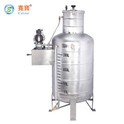
Standard solvent recovery unit: The most common type, suitable for recovering various organic solvents such as alcohol, acetone, and paint thinner. Available in air-cooled and water-cooled models, with the latter offering higher efficiency.
Explosion-proof solvent recovery unit: Features an explosion-proof design added to the standard model, suitable for flammable and explosive cleaning agents, with high safety standards.
Vacuum distillation recovery unit: By creating a vacuum to lower the boiling point, it enables "low-temperature distillation." Its advantages include low energy consumption and high safety, making it particularly suitable for handling heat-sensitive solvents.
Hydrocarbon solvent recovery unit: specifically designed for recovering hydrocarbon solvents, widely used in precision cleaning industries.
Filtration and distillation combination equipment: Some devices first filter out impurities before proceeding with distillation, thereby improving recovery efficiency and purity.
Main application industries
Cleaning agent recovery equipment is widely used across multiple industrial sectors:
Automotive Manufacturing and Repair: Solvent for cleaning and recycling components such as spray guns and engines.
Electronics/Semiconductors: High-purity solvents for cleaning and recycling electronic components and circuit boards.
Precision Instruments/Metalworking: Recycling solvents used in the cleaning process of precision components.
Printing industry: Solvent for cleaning and recycling printing plates and printing machines.
Coatings/Chemicals: Solvents used for cleaning and recycling production equipment and containers.
Others: furniture, sports equipment, optical product manufacturing, etc.